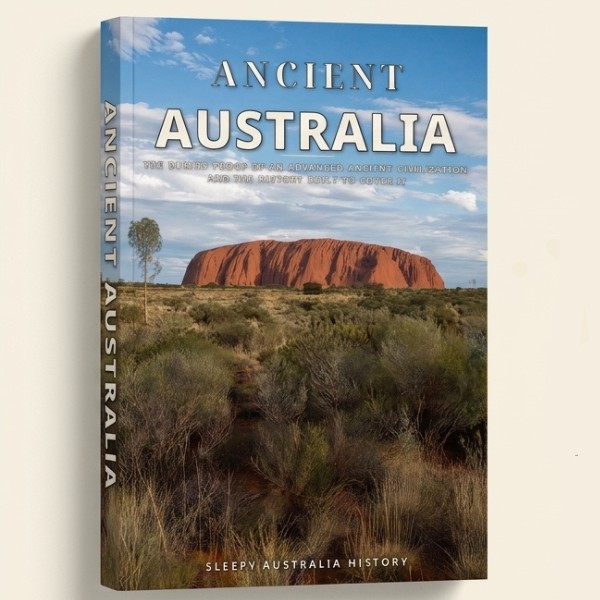
People have lived on this continent for sixty-five thousand years. They built stone aquaculture before the pyramids, ground flour twenty thousand years early and remembered a drowned coastline for ten millennia. This illustrated field guide lays out what is actually in the ground, and how a national story was built to make it look empty.
“I grew up an hour from Budj Bim and was never taught a word about it. The chapter on the stone houses at Lake Condah had me driving out there the next weekend, with the permit sorted first, as the book says.”

Maureen H.61, Ballarat, Victoria
“I came for the Gympie Pyramid and stayed for the ‘What Holds Up’ endings. It's the first book on this topic that tells me when a story is rubbish, and it made the real parts hit harder.”

Liam D.42, Toowoomba, Queensland
“Part Two floored me. Coastal stories that match a sea-floor map from ten thousand years ago. I read the Wadjemup chapter on the ferry to Rottnest and looked at the water very differently.”

Rebecca T.39, Fremantle, Western Australia
Somebody films a stone wall in the Queensland bush, calls it a pyramid, and the video does four million views. Somebody else points out it's a terrace built by Italian farmers growing grapes in the 1880s, and the correction does eleven thousand.
Both of those happened. The correction is true. And almost nobody says the next part out loud: the story underneath the fake one is bigger than the fake one ever was.
Aquaculture six thousand years before Giza. An ochre mine worked for thirty thousand years. A drowned coastline remembered well enough to check against the seafloor.
You don't need a lost race, a visiting Egyptian or a hidden vault for any of it. You only need to accept that a civilisation can be extraordinarily old and extraordinarily sophisticated without looking anything like Rome.
That's also why a real cover-up exists. It wasn't a smoke-filled room. It was a legal doctrine, a set of museum habits, a mining approvals process and a national story that needed the continent to have been empty. Ancient Australia goes through all of it, one short chapter at a time.
| Viral videos | School textbooks | Ancient Australia | |
|---|---|---|---|
| Timeline | “Older than anyone admits”, with no source | A single line about “40,000 years” | 65,000 years, with the digs, the dates and the arguments |
| Hoaxes | Sold as proof | Ignored | Named in the first paragraph and taken apart |
| Engineering | Pyramids that aren't there | Barely mentioned | Budj Bim, Brewarrina, firestick farming, the grain belt |
| The cover-up | A secret society | Not discussed | Terra nullius, collected remains, Juukan Gorge |
| Honesty check | None | None | Every chapter ends with What Holds Up |
| Time to read | Endless scrolling | A semester | 90 short chapters you can read in any order |
Seven parts and ninety chapters, running from what is firmly dated to what falls apart when you look closely. Here's a sample from the real table of contents.
Chapters 1–13 · the timeline that keeps moving back
Chapters 14–26 · the sea rise, and the people who remembered it
Chapters 27–40 · aquaculture, farming and permanent structures
Chapters 41–53 · astronomy, stone arrangements and songlines
Chapters 54–66 · the largest rock-art record on Earth
Chapters 67–78 · the hoaxes, and the contact that really happened
Chapters 79–90 · how a continent was made to look empty
Ancient Australia comes from Sleepy Australian History, made for the parts of the deep past that don't make it into the headline version.
It's a field guide, not a manifesto. Every claim falls under one of three headings: what the evidence shows, what the evidence suggests, and what somebody made up. Traditional place names are used where they are public and established (Murujuga, Wadjemup, Gwion Gwion, Baiame's Ngunnhu), with the colonial name alongside on first mention.
Where a site is restricted, it's described by region only. Treat the geography in here as reading, not as an itinerary.
No. The book is sorted by confidence: established, dated finds first, and contested claims last. Every chapter ends with a section called What Holds Up, and when a story is a hoax, the chapter says so in its first paragraph. What you get is the strongest version of each claim, followed by what the ground actually supports.
The videos give you the claim. The book gives you the claim, the dig, the date, the counter-argument and a verdict, all in one place, across 90 chapters and seven parts. You can read the What Holds Up endings in one sitting and come away knowing more than a hundred hours of video would teach you.
We'd like this to be the book people pick up first, and a low price makes that easier. The price is set for the launch and can change later.
It's an illustrated 140-page PDF. When checkout on Gumroad is complete, you get the download straight away and it's also emailed to you. It works on any phone, tablet, e-reader that opens PDFs, or computer, and it's yours to keep.
No. Each chapter is short and stands on its own. Start with the Gympie Pyramid, Budj Bim or Juukan Gorge, whichever pulled you in.
Yes. The book names deceased people, and a warning up front says so. It describes restricted sites by region only and doesn't encourage anyone to visit, disturb, collect from or photograph a restricted place.
90 short chapters, 7 parts and an honest verdict at the end of every one.
Get Ancient Australia — $14.99
140 illustrated pages and 90 chapters, each with an honest verdict at the end. The launch price ends when the timer does.
Get Ancient Australia — $14.99